Trouble rules
Trouble is a race game for 2 to 4 players. Each player moves 4 pegs once around the board and into a Finish line of their own color. You roll by pressing the Pop-O-Matic, a plastic bubble with the die inside. A 6 brings a peg out of Home, and landing on another player’s peg sends it back.
Also called Frustration.




- Players
- 2 to 4
- Ages
- 5 and up
- You need
- A Trouble game: the board with its Pop-O-Matic die roller, and 16 pegs, 4 in each of 4 colors
- Each turn
- Pop the die once and move one peg that many spaces, or use a 6 to bring a peg out of Home. A 6 earns another pop.
- Goal
- Get all 4 of your pegs once around the board and into your Finish line
- Game ends
- When one player has all 4 pegs in Finish. That player wins. The others may play on for second and third.
- Playing time
- About 30 minutes
TROUBLE and POP-O-MATIC are trademarks of Hasbro. This site is not affiliated with or endorsed by Hasbro.
Quick start
- Each player puts the 4 pegs of one color in the Home of that color. Everyone pops the die once. The highest number goes first, and play passes to the left.
- On your turn, press the Pop-O-Matic once and let go. You need a 6 to move a peg out of Home onto your Start space. Every 6 earns another pop.
- With any other number, move one of your pegs on the track that many spaces clockwise. Count every space, empty or full. You cannot land on your own peg.
- If your peg lands on another player’s peg, that peg goes back to its Home. If none of your pegs can use the number, you lose that move.
- After one trip around the track, a peg moves into the Finish line of its color. It goes in only with the exact number. Pegs in Finish are safe.
- The first player to get all 4 pegs into Finish wins.
Rule sheet and score sheet
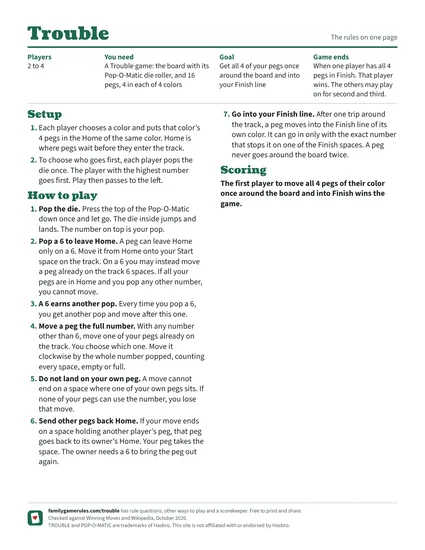
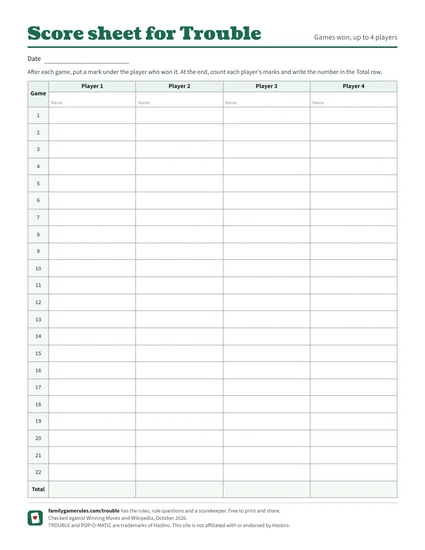
Print the whole game on one page, and a score sheet made for Trouble. Both are free PDFs for Letter paper.
Setup
2 to 4 players, each with the 4 pegs of one color. With 2 players, each may play two colors.
You need: A Trouble game: the board with its Pop-O-Matic die roller, and 16 pegs.
| In the set | Count |
|---|---|
| Red pegs | 4 |
| Blue pegs | 4 |
| Yellow pegs | 4 |
| Green pegs | 4 |
| Total | 16 |
- The die stays inside the Pop-O-Matic, a plastic bubble that is part of the game. You roll it by pressing down on the top and letting go. This is called popping.
- Each player chooses a color and puts that color’s 4 pegs in the Home of the same color. Home is where pegs wait before they enter the track.
- To choose who goes first, each player pops the die once. The player with the highest number goes first. Play then passes to the left.
Red’s Home
Blue’s Home
Yellow’s Home
Green’s Home
No pegs are on the track yet
How to play
On each turn you pop the die once and move one peg. A track of spaces runs around the board. Each color has its own Start space on the track and its own Finish line at the end of the trip.
-
Pop the die
Press the top of the Pop-O-Matic down once and let go. The die inside jumps and lands. The number on top is your pop.
- If the die does not land clearly, the player who popped it may tap the Pop-O-Matic. They may not pop it again while the die is stuck between numbers.
-
Pop a 6 to leave Home
A peg can leave Home only on a 6. Move it from Home onto your Start space on the track. On a 6 you may instead move a peg already on the track 6 spaces. If all your pegs are in Home and you pop any other number, you cannot move.
- If one of your own pegs is on your Start space, you cannot bring another peg out. Use the 6 to move a peg on the track.
- If another player’s peg is on your Start space, you can still bring a peg out. Their peg goes back to its Home, and yours takes the space.
-
A 6 earns another pop
Every time you pop a 6, you get another pop and move after this one.
- You get the extra pop even if your 6 could not move any of your pegs.
-
Move a peg the full number
With any number other than 6, move one of your pegs already on the track. You choose which one. Move it clockwise by the whole number popped, counting every space, empty or full.
- Pegs pass over other pegs, yours included. Only the space where a move ends matters.
- Pegs cannot block. A peg never stops another peg from going past it.
-
Do not land on your own peg
A move cannot end on a space where one of your own pegs sits. If none of your pegs can use the number, you lose that move.
- Pegs in Home can use only a 6. A player whose pegs are all in Home loses each move until they pop a 6.
-
Send other pegs back Home
If your move ends on a space holding another player’s peg, that peg goes back to its owner’s Home. Your peg takes the space. The owner needs a 6 to bring the peg out again.
-
Go into your Finish line
After one trip around the track, a peg moves into the Finish line of its own color. It can go in only with the exact number that stops it on one of the Finish spaces. A peg never goes around the board twice.
- Inside the Finish line, pegs move only the way the arrows point, and only by the exact number popped. The rule against landing on your own peg still applies.
- If the number is too big for a peg to stop on a Finish space, that peg cannot use it. Move another peg if one can use the number.
- Pegs in Finish are safe. Other players’ pegs cannot enter your Finish line, so nobody can send them back.
Example: a 6, the extra pop, then a peg sent back
Red has all 4 pegs in Home. Red pops a 6 and moves one peg onto Red’s Start space. The 6 earns another pop, and Red pops a 3. A 3 cannot bring a peg out of Home, and only one red peg is on the track, so that peg moves 3 spaces. A few turns later a blue peg sits 5 spaces ahead of that red peg. Red pops a 5 and moves the peg onto the blue peg’s space. The blue peg goes back to Blue’s Home.
Red pops a 6

A red peg leaves Red’s Home for Red’s Start space
The extra pop

The same peg moves 3 spaces
A later turn

The red peg ends on the blue peg’s space, 5 spaces ahead
The blue peg goes back to Blue’s Home
Scoring
Trouble has no points. You win by getting all 4 of your pegs into your Finish line first.
The first player to move all 4 pegs of their color once around the board and into Finish wins the game.
Nothing is written down during a game. To play a match, mark the winner of each game on the score sheet and add up the games at the end.
Scorekeeper
Trouble has no points. This counts the games each player wins, so you can play a match. It works in this browser, keeps the game if the page reloads, and needs no account.
Other ways to play
Trouble for 2 players
Play with one color each and the usual rules, or each take two colors if you both want to. With two colors you have 8 pegs, and on each turn you pop once and move one peg of either color. The official rules say the winner gets all 4 pegs of their color into Finish. They do not say whether a player with two colors must finish both, so agree first whether you need all 8 pegs in Finish or one full color.
House rules and other versions
- Play for second and third place
- When one player wins, the others can keep playing to see who finishes second and third.
- Basic play for young children
- Hasbro prints a simpler guide for young children. Each child picks a color and puts a peg of that color on its Start space. Pop the die, move that many spaces, and keep going all the way around the board until the peg reaches the Finish. The guide has no rule about needing a 6.
- Power Die and Shield edition
- This edition pops 2 dice: a number die and a symbol die. The symbol die gives a player a boost around the track. A player who pops the shield symbol gets instant protection from being bumped back. The rule sheet in that box gives the details.
- Road Trip travel edition
- This travel edition comes in a case with a Pop-O-Matic, 2 dice and 18 pegs. Popping a Road Block can trap a player, popping your Passage Peg gives protection, and landing on a Short Cut space lets you cross the board. The rule sheet in that box gives the details.
- Double Trouble
- A variation of Trouble, first published by Milton Bradley in 1987. Each player moves two pieces, and the game uses separate Pop-O-Matic dice rollers.
Rule questions
What do you need to roll to get out of Home in Trouble?
A 6. No other number moves a peg out of Home. The peg goes onto your Start space. If all your pegs are in Home and you pop anything else, you cannot move that turn.
Do you get another turn when you roll a 6 in Trouble?
Yes. Every 6 gives you another pop and move. You get it even if the 6 itself could not move any of your pegs.
Do you have to bring a new peg out when you roll a 6?
No. On a 6 you choose: bring a new peg out of Home onto your Start space, or move a peg already on the track 6 spaces. If one of your own pegs is on your Start space, you cannot bring one out, so you move a peg on the track.
Can you land on your own peg in Trouble?
No. A move can never end on a space where one of your own pegs sits. You may pass over your own pegs, because every space is counted, empty or full.
What happens when you land on another player’s peg?
That peg goes back to its owner’s Home, and your peg takes the space. Its owner needs a 6 to bring it out again. Passing over a peg does nothing. Only the space where your move ends counts.
What if none of your pegs can move?
You lose that move. This happens when all your pegs are in Home and you pop anything but a 6, or when every peg on the track would land on your own peg or overshoot your Finish line. If the number was a 6, you still pop again.
Do you need an exact roll to get into Finish in Trouble?
Yes. A peg goes into its Finish line only with the exact number that stops it on one of the Finish spaces. If the number is too big, that peg cannot use it. Move another peg if one can use the number.
Can a peg in your Finish line be sent back?
No. Other players’ pegs cannot enter your Finish line, so your pegs there are safe.
What if another player’s peg is on my Start space when I roll a 6?
You can still bring a peg out. Their peg goes back to its Home, and yours takes your Start space.
Who goes first in Trouble?
Each player pops the die once, and the highest number goes first. Play then passes to the left.
Can you go around the board more than once?
No. After one trip around the track, a peg goes into the Finish line of its own color. It never starts a second lap.
Can 2 players play with more pegs?
Yes, if you both want to. With 2 players, each may play two colors, 8 pegs in all. The official rules say the winner gets all 4 pegs of their color into Finish. They do not say whether a player with two colors must finish both, so agree first whether a player needs all 8 pegs in Finish or one full color.
Words used in Trouble
- Home
- The area of your color where your 4 pegs start. A peg that is sent back returns here and needs a 6 to come out again. The official rules call it the Home base.
- Start space
- The space on the track where a peg of your color comes in from Home.
- Track
- The path of spaces that runs around the board. Pegs move clockwise along it.
- Finish line
- The row of spaces in your color at the end of a peg’s trip. Only your pegs can go in, and they are safe there.
- Pop-O-Matic
- The plastic bubble that holds the die. Press it down and let go to roll.
- Pop
- To roll the die with the Pop-O-Matic. Also the number you rolled.
- Bump
- To send another player’s peg back to its Home by landing on it.
What you need
- A Trouble gameComes with the board, its built-in Pop-O-Matic die roller and 16 pegs.Find it on Amazon (A Trouble game, opens in a new tab)
- Trouble Road Trip travel gameOptional. A travel version in a portable case. It adds the spaces and symbols listed under Variants.Find it on Amazon (Trouble Road Trip travel game, opens in a new tab)
As an Amazon Associate, we earn from qualifying purchases. How the site is paid for.
Checked against
These rules are written in our own words from Winning Moves and checked against Wikipedia. Sources last checked on October 12, 2026.
- First source: Winning Moves, Classic Trouble rules (2022 sheet, © 2022 Hasbro), licensed by Hasbro. Contents, ages, setup, who goes first, popping, a turn of one pop and a move when a move is possible, the 6 to leave Home, the extra pop, moving clockwise and counting every space, no landing on your own peg, sending pegs Home, the Start space rules, the exact count into Finish, safety in Finish, one lap only, winning, two colors each for 2 players and playing on for second and third.
- Second source: Wikipedia, Trouble (board game). A check on players, the 6 to leave Home, the extra turn on any 6, the Start space rules, landing on pegs, no blocking, clockwise movement and safety in Finish. Also the playing time of about 30 minutes, tapping the Pop-O-Matic, the name Frustration and Double Trouble.
Other sources we used (3)
- Hasbro, TROUBLE Basic Play guide, item A5064 (© 2014 Hasbro, Buffalo and Erie County Public Library copy). The simple game for young children, the ages and the contents.
- Hasbro, Trouble Board Game with Power Die and Shield, item F1358 (instructions page). The Power Die and Shield edition, from the product description.
- Hasbro, Road Trip Series Trouble Game, item E5342 (instructions page). The Road Trip travel edition, from the product description.
Where the sources differ (10)
| Topic | Winning Moves | Wikipedia | This page |
|---|---|---|---|
| Where a peg goes when it is landed on | Back to its owner’s Home base, to start over. | Back to the start. Elsewhere the article calls the waiting area home and the entry space start. | Back to Home, following the Winning Moves sheet. Hasbro’s Power Die edition page says a peg is bumped back to start, without saying which space. |
| A 6 that cannot be used | Every 6 earns another pop and move. It does not say what happens when the 6 cannot move any peg. | A 6 gives another turn even when no piece can move. | Follows Wikipedia: the extra pop still comes. |
| Another player’s peg on your Start space | You can still bring a peg out on a 6, and their peg goes back to its Home base. | You can still bring a piece out. It does not say what happens to the other piece. | Follows the Winning Moves sheet. The two agree as far as Wikipedia goes. |
| Exact count into Finish | A peg enters Finish only with the exact number needed to reach a Finish space, and moves inside Finish only along the arrows by exact count. | Not covered. Says pieces are safe in the final four slots of the finish area. | Follows the Winning Moves sheet. The page gives no count of Finish spaces, since only Wikipedia’s phrase hints at one. |
| Tapping the Pop-O-Matic | Not covered. Only says to press down once and let go. | If the die does not land clearly, the player who popped may tap the Pop-O-Matic but may not pop again. | Gives Wikipedia’s rule as a note under popping. |
| Who goes first | Each player pops once and the highest number goes first. Play passes to the left. | Not covered. | Follows the Winning Moves sheet. |
| Blocking and passing pegs | Count every space, empty or full. Says nothing directly about blocking. | Pieces cannot be placed to block other players, unlike in Parcheesi. | Pegs pass over any peg and cannot block, from both. |
| Going around more than once | A peg enters its Finish line after one trip around and can never go around twice. | Not covered. | Follows the Winning Moves sheet. |
| 2 players | Each player may play two sets of pegs if wanted. | Not covered. | Gives the two-color option. The sheet’s win rule speaks of the 4 pegs of one color and does not say whether a player with two colors must finish both, so the page says to agree first. |
| Name of the starting area | HOME BASE, with a START space on the track. | Home, with a start space. Hasbro’s Basic Play guide says start space and Finish Zone. | Home, Start space and Finish line. |
What on this page is our own
- The example of a 6, an extra 3 and a later 5 is our own.
- That a move no peg can use is lost is our reading of the Winning Moves sheet, which says a turn is “one pop and a move (if possible)”. The sheet also says it for a first turn with no 6. Wikipedia says only that a player may be unable to move.
- Moving another peg when a number is too big for Finish, and the rule against landing on your own peg applying inside Finish, are our readings of the sheet’s general rules.
- That pegs pass over other pegs, yours included, and that only the space where a move ends matters, is our reading of the rule to count every space, empty or full.
- In the 2-player version with two colors, popping once and moving one peg of either color, and the advice to agree on how the game is won, are our own. The sheet gives only the option of two sets of pegs.
- The name Frustration comes from Wikipedia, which says the game is known by that name in the UK. We did not check a Frustration rule sheet.
- The notes under What you need describe products and are not rules.
- The pieces pictured at the top of the page are our own example.
Spotted a mistake? Email [email protected] and we'll check it against the sources.