Checkers rules
Checkers is a game for 2 players on an 8 by 8 board. Each player has 12 pieces that move along the dark squares, and you capture by jumping over the other player’s pieces. In Britain the same game is called draughts. Its key rule is that a jump is never optional: if you can jump, you must.
Also called Draughts, English draughts.




- Players
- 2
- You need
- A checkerboard of 8 by 8 squares and 24 pieces, 12 in each of two colors
- Each turn
- Move one piece one square diagonally, or jump to capture. If you can jump, you must.
- Goal
- Capture all the other player’s pieces, or leave them with no move
- Game ends
- When a player has no pieces left or cannot move, or when the game is drawn
- Playing time
- Usually 10 to 30 minutes for a casual game
Quick start
- Set the board so each player has a dark square in the corner at their left. Each player puts 12 men on the dark squares of the 3 rows nearest them.
- Black moves first, then you take turns. A man moves one square diagonally forward onto an empty dark square.
- To capture, jump over the other player’s piece when it sits diagonally next to yours and the square beyond it is empty. Take the jumped piece off.
- If you can jump, you must. If the same piece can jump again, keep going. When you have a choice of jumps, take any one you like.
- A man that reaches the far row becomes a king, and your turn ends there. Kings move and jump one square diagonally, forward or backward.
- You win when the other player has no pieces left or cannot make a move. If neither of you can force a win, the game is a draw.
Rule sheet and score sheet
Print the whole game on one page, and a score sheet made for Checkers. Both are free PDFs for Letter paper.
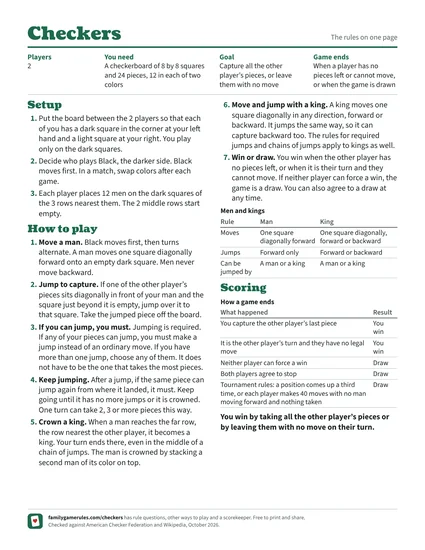
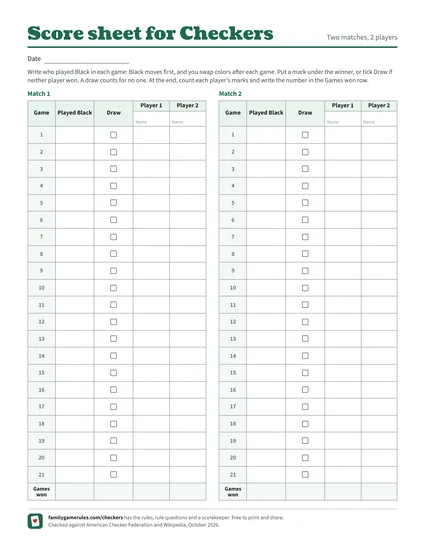
Setup
2 players.
You need: A checkerboard of 64 squares and 24 pieces, 12 of each color.
| In the set | Count |
|---|---|
| Black pieces | 12 |
| Red pieces | 12 |
| Total | 24 |
- Sets in the United States are often black and red. Official tournament pieces are red and white. Checkers books usually call the darker side Black and the lighter side White, whatever the real colors. Black moves first, so red goes first in a red and white set.
- Only the 32 dark squares are used. A chess board works as a checkerboard.
- Some sets have a crown on one side of each piece. Turn a piece crown up to show it is a king instead of stacking two.
- Put the board between the 2 players so that each of you has a dark square in the corner at your left hand and a light square at your right. You play only on the dark squares.
- Decide who plays Black, the darker side. Black moves first. In a match, swap colors after each game.
- Each player places 12 men on the dark squares of the 3 rows nearest them. The 2 middle rows start empty.
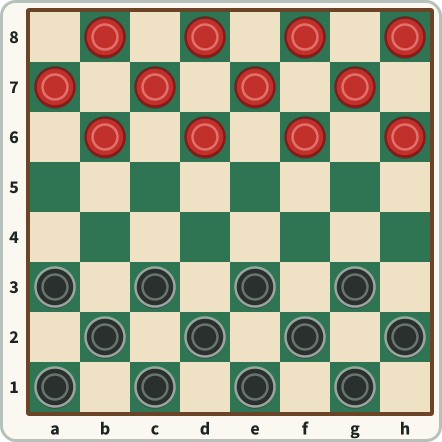
- The diagrams on this page name each square by its column, a to h from left to right, and its row, 1 to 8 from the near side. So a1 is the dark square in your left-hand corner.
- The diagrams show a black and red set, so black is the darker side and red the lighter side.
- Checkers books and printed diagrams often show the pieces on the light squares so they are easier to see. At the board, you always play on the dark squares.
- A piece that is not a king is called a man.
How to play
Players take turns, one move per turn. On your turn you either move one piece or make a jump.
-
Move a man
Black moves first, then turns alternate. A man moves one square diagonally forward onto an empty dark square. Men never move backward.
- If you have no legal move on your turn, you lose the game.
-
Jump to capture
If one of the other player’s pieces sits diagonally in front of your man and the square just beyond it is empty, jump over it to that square. Take the jumped piece off the board.
- A man jumps forward only, the same as it moves.
- A man can jump a king.
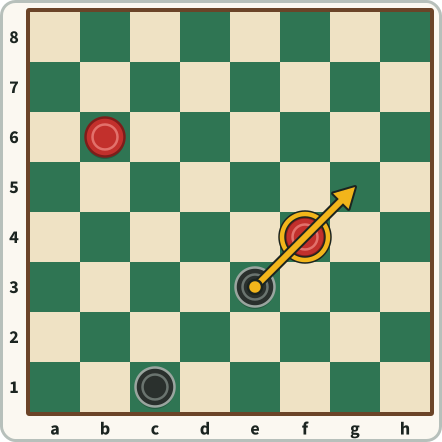
Black jumps from e3 over the red man on f4 and lands on g5. The red man comes off the board. -
If you can jump, you must
Jumping is required. If any of your pieces can jump, you must make a jump instead of an ordinary move. If you have more than one jump, choose any of them. It does not have to be the one that takes the most pieces.
- The jump is required even when it leads you into trouble.
- In tournament rules, skipping a jump is an illegal move. The first time, the player is cautioned and the move is taken back. Another illegal move in the same game loses the game.
- An old rule called huffing, where a skipped jump costs you the piece, is not in today’s official rules. It is under Variants below.
-
Keep jumping
After a jump, if the same piece can jump again from where it landed, it must. Keep going until it has no more jumps or it is crowned. One turn can take 2, 3 or more pieces this way.
- Each jump in the chain can change direction, as long as a man always jumps forward.
- Once you start a chain of jumps, you must finish it. You can choose which chain to take, but not stop partway.
-
Crown a king
When a man reaches the far row, the row nearest the other player, it becomes a king. Your turn ends there, even in the middle of a chain of jumps. The man is crowned by stacking a second man of its color on top.
- The far row is called the king row.
- A new king cannot jump again until your next turn, even if a jump is waiting for it.
-
Move and jump with a king
A king moves one square diagonally in any direction, forward or backward. It jumps the same way, so it can capture backward too. The rules for required jumps and chains of jumps apply to kings as well.
- A king moves only one square at a time. Kings that slide any distance along a diagonal belong to other draughts games, such as Russian draughts and pool checkers. They are listed under Variants.
- A king can be jumped by a man or by another king.
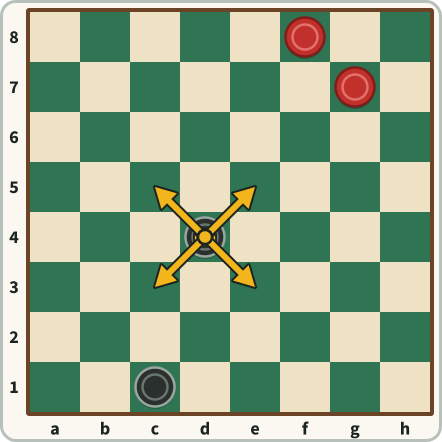
A black king on d4 can move to any of the 4 dark squares touching its corners, forward or backward. -
Win or draw
You win when the other player has no pieces left, or when it is their turn and they cannot move. If neither player can force a win, the game is a draw. You can also agree to a draw at any time.
- A player whose pieces are all blocked loses, even with pieces still on the board.
- Tournament rules also make it a draw when a move would bring about the same position for the third time, or when, over each player’s last 40 moves, no man has moved forward and no piece has been taken.
| Rule | Man | King |
|---|---|---|
| Moves | One square diagonally forward | One square diagonally, forward or backward |
| Jumps | Forward only | Forward or backward |
| Can be jumped by | A man or a king | A man or a king |
Example: a required double jump that crowns a king
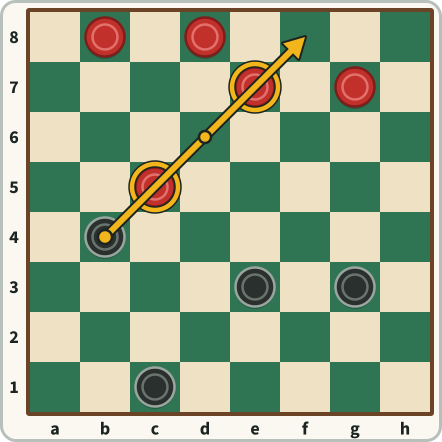
It is Black’s turn. Black’s man on b4 can jump the red man on c5, and since jumping is required, Black must take it. The man lands on d6. From there it can jump the red man on e7, so it must keep going. It lands on f8, the far row, and is crowned. Black’s turn ends there. The new king could jump the red man on g7 by moving backward to h6, but only on Black’s next turn, if that man is still there.
Scoring
Checkers has no points. Each game ends in a win for one player or in a draw.
| What happened | Result |
|---|---|
| You capture the other player’s last piece | You win |
| It is the other player’s turn and they have no legal move | You win |
| Neither player can force a win | Draw |
| Both players agree to stop | Draw |
| Tournament rules: a position comes up a third time, or each player makes 40 moves with no man moving forward and nothing taken | Draw |
You win by taking all the other player’s pieces or by leaving them with no move on their turn.
At home, nothing is written down during a game. To play a match, mark the winner of each game on the score sheet, swap colors for the next game, and count the wins at the end. On our score sheet a drawn game gives neither player a mark.
A worked example: a four-game match
Ana and Ben play 4 games and swap colors each time. Ana wins game 1 with Black. Ben wins game 2. Game 3 is a draw, so neither gets a mark on the score sheet. Ana wins game 4. Ana takes the match, 2 games to 1.
| What happened | Goes to | Points |
|---|---|---|
| Game 1: Ana wins | Ana | 1 |
| Game 2: Ben wins | Ben | 1 |
| Game 4: Ana wins | Ana | 1 |
| Ana | 2 | |
| Ben | 1 |
Scorekeeper
Checkers has no points. This scorekeeper counts the games each player wins in a match. It leaves drawn games out of the count. It works in this browser, keeps the game if the page reloads, and needs no account.
Other ways to play
House rules and other versions
- Huffing (the old rule)
- Under this old rule, when a player could jump but moves another way, the other player chooses before making their own move. They can take off the piece that should have jumped, make the player take the jump, or let the move stand. Taking the piece off is called a huff, and it does not count as a turn.
- Keep jumping after crowning
- A man that becomes a king partway through a chain of jumps carries on jumping as a king in the same turn. Player associations do not recognize this rule.
- Kings capture first
- When a king and a man can both make a capture, the king must be the one to do it. Player associations do not recognize this rule.
- Optional jumping
- Some groups play that you never have to jump, and a skipped jump has no penalty. The official rules make jumping required.
- Giveaway checkers
- Also called suicide checkers, losing draughts or anti-checkers. The goal is turned around: the first player to lose all their pieces wins.
- Flying kings (Russian draughts)
- In Russian draughts, played on the same 8 by 8 board, a king can move any number of squares along a diagonal, and men can jump backward. Kings like this are called flying kings. They are not used in checkers.
- International draughts
- Played on a 10 by 10 board with 20 pieces each. Kings fly any distance, men can jump backward, and you must take the chain of jumps that captures the most pieces.
- Pool checkers
- Played mainly in the southeastern United States on the usual 8 by 8 board. Kings fly: they move any distance along a diagonal. Men can jump backward as well as forward.
Rule questions
Do you have to jump in checkers?
Yes. If any of your pieces can jump, you must make a jump that turn, even if it costs you later. If you have more than one jump, you choose which. You do not have to pick the one that takes the most pieces.
Who moves first in checkers, red or black?
The darker side, which checkers books usually call Black. In a black and red set, black goes first. In a red and white set, like the official tournament pieces, red is the darker color and goes first. In a match, players swap colors after each game.
If a man is crowned in the middle of a jump, can it keep jumping?
No. When a man reaches the far row it is crowned and the turn ends, even if it could jump again as a king. It can make that jump on your next turn if it is still there. Some groups let the new king carry on, but player associations do not recognize that rule.
What is huffing in checkers?
An old rule for a missed jump. If a player failed to make a jump, the other player could take the piece that should have jumped off the board, then take their own turn. Huffing is not in today’s official rules, where every jump is required. Agree before you play if your group wants to use it.
What happens if someone misses a jump?
In tournament rules, a missed jump is an illegal move. The first time, the player is cautioned and the move is taken back. Any later illegal move in that game loses the game. Once the other player has made their next move, the illegal move stands. The older official rules let the other player choose instead: make you take the jump, huff the piece, or let the move stand.
If you touch a piece, do you have to move it?
Yes, in tournament rules. If you touch a piece on your turn, you must play it, unless you first said you were straightening pieces. Touching a piece that has no legal move counts as an illegal move. Once any part of a piece is pushed over a corner of its square, it must finish its move in that direction. Agree first whether to play this way.
Can a regular piece move or jump backward?
No. A man moves and jumps forward only. Only a king can move or jump backward.
Can a man jump a king?
Yes. Any piece can jump a king, whether it is a man or another king.
Can a king move more than one square?
Not in checkers. A king moves one square at a time and jumps one piece at a time, though it can chain jumps like any piece. Kings that slide any distance, called flying kings, belong to other draughts games, such as Russian draughts, international draughts and pool checkers.
What happens if a player cannot move?
They lose. A player with no legal move on their turn has lost, even if they still have pieces on the board.
How does a game of checkers end in a draw?
Both players agree, or neither can force a win. Tournament rules also allow a draw when a move would repeat a position for the third time, or when, over each player’s last 40 moves, no man has moved forward and no piece has been taken. The older official rules had a different count: after notice, the stronger side had 40 of their own moves to win or show a clear advantage.
Which way does the checkerboard go?
Each player should have a dark square in the corner at their left hand. The pieces start on the dark squares, and only the dark squares are used.
Words used in Checkers
- Man
- An ordinary piece that is not a king. It moves and jumps forward only.
- King
- A man that has reached the far row. It is two men stacked and can move and jump backward as well as forward.
- King row
- The row nearest each player. Your men are crowned when they reach the other player’s king row. Also called the crownhead.
- Jump
- A capture. Your piece hops diagonally over the other player’s piece to the empty square beyond, and the jumped piece comes off.
- Double jump
- Two jumps in one turn by the same piece. A chain can be longer, and it must be finished once started.
- Huff
- Under an old rule, taking off a piece that failed to make a jump it could have made. Also called a blow.
- Single corner
- The dark square in the corner at each player’s left.
- Black and White
- The names checkers books usually give the two sides, whatever the real colors. The darker side is Black and moves first, and the lighter side is White. In a red and white set, red counts as Black.
- Flying king
- A king that moves any distance along a diagonal. Used in Russian draughts, international draughts and pool checkers, not in checkers.
What you need
- A checkers setA board of 64 squares with 24 pieces, 12 of each color.Find it on Amazon (A checkers set, opens in a new tab)
- A roll-up or folding boardOptional. Easy to carry, and many come with chess pieces too.Find it on Amazon (A roll-up or folding board, opens in a new tab)
- A giant checkers setOptional. Large pieces and a floor or lawn mat for playing outdoors.Find it on Amazon (A giant checkers set, opens in a new tab)
As an Amazon Associate, we earn from qualifying purchases. How the site is paid for.
Checked against
These rules are written in our own words from American Checker Federation and checked against Wikipedia. Sources last checked on October 12, 2026.
- First source: American Checker Federation, Checkers in a Nutshell, by Richard Pask. The board with a dark square at the near left, playing on the dark squares, Black first, required jumps with a free choice among them, men jumping kings, crowning ending the move, kings moving backward, and how a game is won.
- Second source: Wikipedia, English draughts. The 8 by 8 board, 12 men each on 3 rows, colors, the darker side first, the casual playing time, moves and jumps of men and kings, chains of jumps, crowning, draws, huffing and the two unrecognised variants.
Other sources we used (3)
- Wikipedia, Checkers. Flying kings, Russian and international draughts, optional capture, giveaway checkers and pool checkers.
- P. H. Ketchum, Checkers: The Handy Manual (1923), The Standard Laws. The older official laws: single corner at the left, swapping colors each game, touch and move, the huff and its options, a new king not moving again that turn, and the 40-move count.
- World Checkers Draughts Federation, WCDF Rules of Draughts, linked from the American Checker Federation’s site as its Tournament Rules. The current tournament rules: the official red and white pieces with Red moving first, alternating colors each game, touch and move, the penalty for a missed jump and other illegal moves, and draws by a third repetition or 40 moves without progress.
Where the sources differ (10)
| Topic | American Checker Federation | Wikipedia | This page |
|---|---|---|---|
| Where the board’s dark corner goes | A black square in the bottom left-hand corner. | Not covered. | A dark square in each player’s left-hand corner. The 1923 Standard Laws say the same: a single corner at each player’s left. |
| Board size and number of pieces | Not stated in words. Squares are numbered 1 to 32. | 8 by 8 board, 12 men each on the dark squares of the 3 nearest rows. | Follows Wikipedia. The Standard Laws’ starting squares 1 to 12 and 21 to 32 agree. |
| Piece colors and who moves first | The sides are Black and White. Black moves first. | Red and white traditionally and in tournaments, black and red common in the US. The darker side is called Black and moves first. | Black and red pieces in the diagrams. The darker side is called Black and moves first, so black goes first in a black and red set and red in a red and white set. The WCDF rules give red and white as the official colors and have Red move first. |
| Chains of jumps | Not covered. | A piece that can jump again must. The chosen chain must be finished, and it may change direction. | Follows Wikipedia. |
| How kings move and jump | Kings move backward and forward. How they jump is not stated. | Kings move and jump one square in any diagonal direction. | Follows Wikipedia. The Checkers article confirms there are no flying kings in American checkers. |
| Crowning in the middle of a jump | Crowning ends the player’s move. | Crowning ends the move. Carrying on as a king is a variant player associations do not recognize. | The move ends. Carrying on is a variant and in the rule questions. The Standard Laws also say a new king does not move again in the same play. |
| Draws | Not covered. | By agreement, or when neither side can force a win. No move count. | Agreement or no possible win, from Wikipedia. The WCDF rules’ draws by a third repetition and by 40 moves each with no man advanced and nothing taken are in a play step note, the scoring table and a rule question. The 1923 Standard Laws’ 40-move count is in the rule question as the older rule. |
| Missing a jump and huffing | All jumps must be taken. No penalty or huff mentioned. | Jumping is mandatory. Huffing is an old rule, out of favor and not in the WCDF rules. | Jumping is required. A missed jump is treated as the WCDF rules treat an illegal move: a caution and the move taken back the first time, a lost game after that, and the move stands once the opponent has moved. Huffing, with the Standard Laws’ three choices, is a variant and in the rule questions. |
| Touch and move | Not covered. | Not covered. | A rule question gives touch and move from the WCDF rules, with a line to agree on it first. The 1923 Standard Laws’ stricter penalty, losing the game, is left out. |
| Colors over several games | Not covered. | In tournament play, each chosen opening is played twice, and each player has a turn at either side. | Swap colors after each game, as in the Standard Laws and the WCDF rules. |
What on this page is our own
- All the diagrams and the worked examples, including the four-game match, are our own.
- The 32 dark squares, the 64 squares in all, the 2 empty middle rows and the 24 pieces in all are our arithmetic from the 8 by 8 board and 12 men on 3 rows each.
- That the black pieces play as Black in a black and red set is our reading of the rule that the darker side is Black.
- That a chess board works as a checkerboard is our remark. Both are 8 by 8.
- Turning a crowned piece crown side up to show a king is our reading of Wikipedia’s note on sets with crowns on the pieces.
- The note that jumping is required even when it leads into trouble follows Wikipedia’s statement that the jump is mandatory even at a disadvantage.
- The square names a1 to h8 used in the diagrams are the site’s own labels. Official checkers notation numbers the dark squares 1 to 32.
- In their draw rules, the Standard Laws and the WCDF rules both ask a player to satisfy an umpire or referee. At home there is no referee, so the page leaves that out.
- Optional jumping is described from the Checkers article’s remark that some rule variations make capturing optional. The line that a skipped jump then has no penalty is our reading of optional.
- The notes under What you need describe products and are not rules.
- The wording of the Kings capture first variant is our reading of an unclear sentence in Wikipedia’s English draughts article: a king’s capture comes before a man’s.
- That the corner square at each player’s right is light follows from the board’s pattern once the left-hand corner is dark.
- The pieces pictured at the top of the page are our own example.
- Leaving drawn games out of the match count is how our score sheet and scorekeeper work, not a rule. The 1923 Standard Laws say a match should count wins and draws.
Spotted a mistake? Email [email protected] and we'll check it against the sources.