Trash (Garbage) rules
Trash, also called Garbage, is a card game of luck for 2 to 6 players. Each player has 10 face-down cards that stand for ace through 10, and turns them up by drawing the right cards. Fill every place first and your next layout is one card shorter. The first player to win a round with a single card wins.
Also called Garbage, Ten.
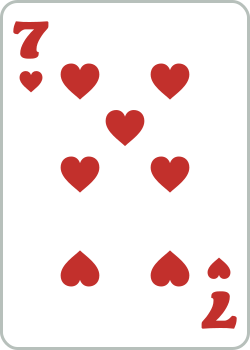
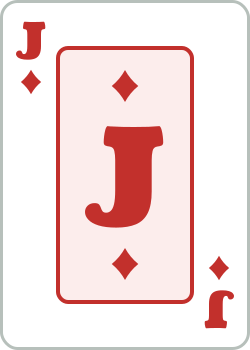
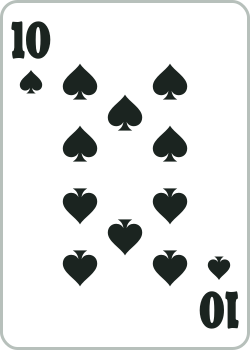
- Players
- 2 to 6, each playing alone
- You need
- One standard 52-card deck for 2 players, two decks for 3 or 4, three decks for 5 or 6
- Deal
- 10 cards each, face down, in 2 rows of 5. Each place stands for a rank from ace to 10.
- Goal
- Be first to have the right card face up in every place of your layout
- Game ends
- When a player who is down to 1 card fills that place and wins the round
- Playing time
- About 30 to 60 minutes
Quick start
- Deal each player 10 cards face down in 2 rows of 5. The top row is your ace to 5 places and the bottom row is 6 to 10. Do not look at them.
- On your turn, draw the top card of the stock or the discard pile. The first player of each round must draw from the stock.
- Put an ace to 10 in its own place face up. Pick up the face-down card that was there and place it the same way. Keep going.
- A jack is wild and can fill any face-down place. Your turn ends on a queen, a king or a number you cannot use. Discard it face up.
- The first player with every place filled face up wins the round. Next round that player gets one card fewer and drops their highest place.
- The game ends when a player who is down to 1 card, the ace place, fills it with an ace or a jack and wins that round.
Rule sheet and score sheet
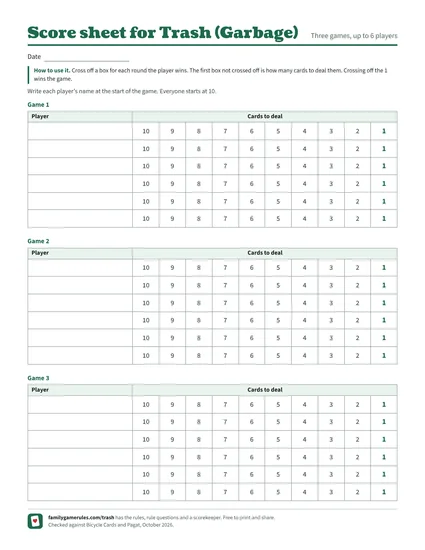
Print the whole game on one page, and a score sheet made for Trash (Garbage). Both are free PDFs for Letter paper.
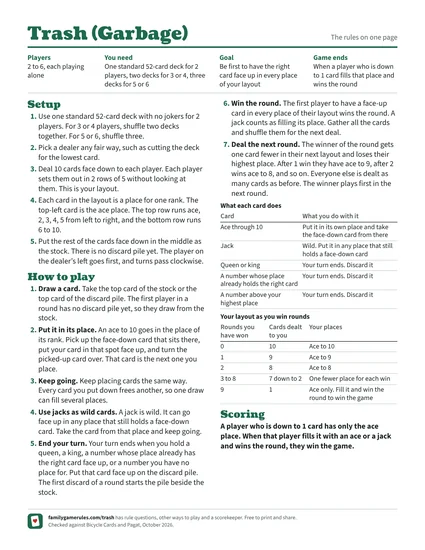
Setup
2 to 6 players, each playing alone. Use one deck for 2 players, two for 3 or 4 and three for 5 or 6.
You need: One standard 52-card deck with the jokers taken out, for 2 players.
| In the set | Count |
|---|---|
| Aces | 4 |
| Number cards, 2 through 10 | 36 |
| Jacks | 4 |
| Queens and kings | 8 |
| Total | 52 |
- Aces and number cards go in the place of their rank. Jacks are wild. Queens and kings end your turn.
- With 3 or 4 players, shuffle two decks together. With 5 or 6, shuffle three. Extra decks keep the stock from running out.
- Suits do not matter. Any 6 fills the 6 place.
- Use one standard 52-card deck with no jokers for 2 players. For 3 or 4 players, shuffle two decks together. For 5 or 6, shuffle three.
- Pick a dealer any fair way, such as cutting the deck for the lowest card.
- Deal 10 cards face down to each player. Each player sets them out in 2 rows of 5 without looking at them. This is your layout.
- Each card in the layout is a place for one rank. The top-left card is the ace place. The top row runs ace, 2, 3, 4, 5 from left to right, and the bottom row runs 6 to 10.
- Put the rest of the cards face down in the middle as the stock. There is no discard pile yet. The player on the dealer’s left goes first, and turns pass clockwise.
| Players | Each player gets | Notes |
|---|---|---|
| 2 | 10 cards | One deck. 32 cards are left for the stock. |
| 3 or 4 | 10 cards | Two decks, 104 cards. The stock holds 74 cards with 3 players and 64 with 4. |
| 5 or 6 | 10 cards | Three decks, 156 cards. The stock holds 106 cards with 5 players and 96 with 6. |
Top row: ace, 2, 3, 4, 5
Bottom row: 6, 7, 8, 9, 10
Stock
The undealt cards, face down
- These are the deal sizes for the first round only. In later rounds a player who has won a round is dealt fewer cards, as explained below.
- The two rule sources we checked do not say how to pick the first dealer or who deals later rounds. Any fair way works.
How to play
Turns pass clockwise. One turn can fill several places, because each card you put down frees the face-down card that was under it. The turn goes on until you hold a card you cannot use.
-
Draw a card
Take the top card of the stock or the top card of the discard pile. The first player in a round has no discard pile yet, so they draw from the stock.
- Only the top card of the discard pile can be taken.
-
Put it in its place
An ace to 10 goes in the place of its rank. Pick up the face-down card that sits there, put your card in that spot face up, and turn the picked-up card over. That card is the next one you place.
- Suits do not matter. A 4 of any suit fills the 4 place.
- You may not look at a face-down card in your layout until a card you place frees it.
- The turn goes on until you reach a card you cannot use. You may not stop early and discard a number card that has a face-down place waiting for it.
-
Keep going
Keep placing cards the same way. Every card you put down frees another, so one draw can fill several places.
-
Use jacks as wild cards
A jack is wild. It can go face up in any place that still holds a face-down card. Take the card from that place and keep going.
- If you later get the real card for a place that holds a jack, you can put it there and move the jack to another place that still holds a face-down card. Take the card from that place and keep going.
- Swapping is your choice. If you do not swap, the number card ends your turn and goes on the discard pile.
- A jack in a place counts as filling it at the end of the round.
-
End your turn
Your turn ends when you hold a queen, a king, a number whose place already has the right card face up, or a number you have no place for. Put that card face up on the discard pile. The first discard of a round starts the pile beside the stock.
- A player who has won rounds has fewer places, and numbers above their highest place are no use to them. With 9 places, a 10 ends the turn.
- If the stock runs out, leave the top card of the discard pile where it is. Shuffle the rest of the discard pile and turn it face down as a new stock.
-
Win the round
The first player to have a face-up card in every place of their layout wins the round. A jack counts as filling its place. Gather all the cards and shuffle them for the next deal.
- The rule sources we checked give the other players no last turn. The round ends as soon as one layout is complete.
-
Deal the next round
The winner of the round gets one card fewer in their next layout and loses their highest place. After 1 win they have ace to 9, after 2 wins ace to 8, and so on. Everyone else is dealt as many cards as before. The winner plays first in the next round.
- A player’s places always start at the ace and count up along the rows, so a 9-card layout has a top row of ace to 5 and 4 cards below for 6 to 9.
| Card | What you do with it |
|---|---|
| Ace through 10 | Put it in its own place and take the face-down card from there |
| Jack | Wild. Put it in any place that still holds a face-down card |
| Queen or king | Your turn ends. Discard it |
| A number whose place already holds the right card | Your turn ends. Discard it |
| A number above your highest place | Your turn ends. Discard it |
| Rounds you have won | Cards dealt to you | Your places |
|---|---|---|
| 0 | 10 | Ace to 10 |
| 1 | 9 | Ace to 9 |
| 2 | 8 | Ace to 8 |
| 3 to 8 | 7 down to 2 | One fewer place for each win |
| 9 | 1 | Ace only. Fill it and win the round to win the game |
Example: one turn that fills four places
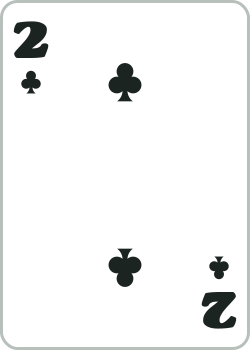
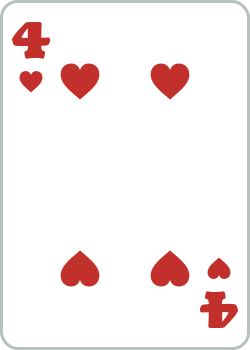
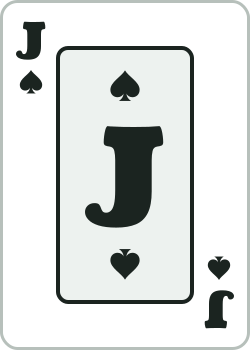
It is the first turn of a round, and all 10 of your cards are face down. You draw the 4 of hearts from the stock and put it in the 4 place. The card under it is the jack of spades. You put the jack in the 8 place, and the card there is the 2 of clubs. It goes in the 2 place, which frees the 8 of diamonds. The 8 place holds your jack, so you put the 8 there and move the jack to the 6 place. Under it is the queen of hearts. A queen ends your turn, so it starts the discard pile.
Top row: ace to 5
Bottom row: 6 to 10
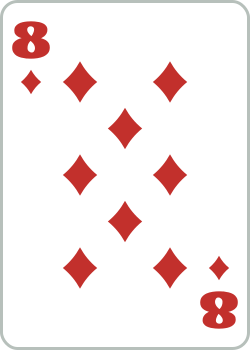
The jack fills the 6 place
Discard pile
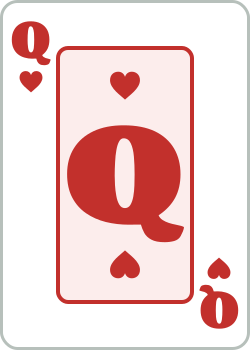
The queen ended the turn
Scoring
Trash has no points. Each round you win takes one card off your next layout, and the game is a race down from 10 cards to 1.
A player who is down to 1 card has only the ace place. When that player fills it with an ace or a jack and wins the round, they win the game.
Write each player’s name with the numbers 10 down to 1 beside it. Cross off one number, starting from 10, each time that player wins a round. The highest number not crossed off is how many cards to deal them next. Crossing off the 1 wins the game.
Scorekeeper
Each player starts at 10 cards. Tap a player when they win a round, and their number drops by one. It shows how many cards to deal each player next. A player who wins a round with 1 card wins the game. It works in this browser, keeps the game if the page reloads, and needs no account.
Other ways to play
House rules and other versions
- Kings wild
- Kings are the wild cards instead of jacks. Jacks and queens both end your turn.
- All picture cards wild
- Jacks, queens and kings are all wild. The only cards that end your turn are numbers whose place is already filled and numbers above your highest place.
- Jokers
- Add jokers to the deck as extra wild cards.
- A shorter game
- Agree on a smaller goal before you start. For example, the first player to get down to a 6-card layout wins.
- Play for a set time
- Play an agreed number of rounds, or for an agreed time. Then the player with the smallest layout wins.
- Take turns going first
- The first turn of each round passes clockwise instead of going to the last round’s winner.
- Check the other layouts
- When a round ends, the other players turn up their face-down cards. A player whose turned-up cards all turn out to be in their right places also gets one card fewer next round.
- Three free draws for 2 players
- This goes with Check the other layouts. In a 2-player game, the player who did not finish gets 3 more draws to try to complete their layout before turning up their cards.
Rule questions
How many cards do you deal in Trash?
10 to each player at the start, face down in 2 rows of 5, standing for ace to 10. A player who has won a round is dealt one card fewer for each round they have won.
How many decks do you need for Trash?
One 52-card deck for 2 players, two decks for 3 or 4 players and three decks for 5 or 6. More players can add more decks so the stock does not run out.
What do jacks do in Trash?
Jacks are wild. A jack can fill any place that still holds a face-down card. You then take the card from that place and keep going. Some groups make kings wild instead.
Can you swap a jack out for the real card?
Yes. If you get the real card for a place that holds a jack, you can put it there. The jack then moves to another place that still holds a face-down card, and you take the card from that place and carry on.
What do queens and kings do?
They end your turn. Put the queen or king face up on the discard pile, and the next player takes their turn.
Do the other players get one more turn when someone fills their layout?
Not under the rules we checked. They give no last turn, so the round ends when one player’s layout is complete. If your group wants a last turn for everyone, agree on it before the first deal.
Does a jack count at the end of the round?
Yes. A jack face up in a place counts as filling it. You can even win the game by filling your last place, the ace, with a jack.
Do the players who did not win a round lose a card?
No. Only the winner of a round gets one card fewer. Everyone else is dealt the same number as in the round before. Some groups also shorten the layout of a player whose remaining cards all turn out to be in their right places.
What happens if you draw a 10 after winning a round?
Your turn ends. After one win you have only ace to 9, so a 10 has no place and goes on the discard pile. After two wins the same goes for 9s, and so on.
Can you take the top card of the discard pile?
Yes, on any turn except the very first turn of a round, when there is no discard pile yet. Only the top card can be taken.
What happens when the stock runs out?
Leave the top card of the discard pile in place. Shuffle the rest of the discard pile and turn it face down as a new stock.
Who goes first in the next round?
The player who won the last round. Some groups pass the first turn clockwise from round to round instead.
Words used in Trash (Garbage)
- Layout
- Your cards set out in front of you. It starts as 2 rows of 5.
- Place
- One spot in your layout. Each place stands for one rank, from the ace at the top left up to 10.
- Round
- One deal, played until one player fills every place. Also called a hand.
- Stock
- The face-down pile of undealt cards that players draw from.
- Discard pile
- The face-up pile of cards that ended a turn. Only its top card can be taken.
- Wild card
- A card that can stand in for any rank. In Trash the jacks are wild.
What you need
- A standard deck of playing cardsOne 52-card deck is enough for 2 players. Take the jokers out.Find it on Amazon (A standard deck of playing cards, opens in a new tab)
- Extra decksTwo decks for 3 or 4 players and three for 5 or 6. Decks with matching backs are easier to shuffle together.Find it on Amazon (Extra decks, opens in a new tab)
- Paper and a pencilTo track how many cards each player is dealt. Our printable sheet has a row for each player.Find it on Amazon (Paper and a pencil, opens in a new tab)
As an Amazon Associate, we earn from qualifying purchases. How the site is paid for.
Checked against
These rules are written in our own words from Bicycle Cards and checked against Pagat. Sources last checked on October 12, 2026.
- First source: Bicycle Cards, Trash. Players and decks, the 10-card deal in 2 rows of 5 with the ace at top left, the turn, wild jacks, queens and kings ending the turn, the stock running out, the winner’s shorter layout, the winner playing first, and winning the game with an ace or a jack in the last place.
- Second source: Pagat, Trash. Confirms every main rule, including the deck counts and the winner’s shorter layout. The other names Garbage and Ten, that only the winner’s layout shrinks in the main rule, and all of the variants.
Where the sources differ (5)
| Topic | Bicycle Cards | Pagat | This page |
|---|---|---|---|
| Number of players | Info box lists 2, 3, 4 and 5+. Deck counts are given up to 6 players. | 2 or more. Deck counts up to 6 players, and more decks can be added with more players. | 2 to 6, the range both deck tables cover. A rule question says more players can add more decks. |
| Ages | 8 and up, in the info box. | Not stated. | Not shown. The site’s pages for traditional card games leave out the age labels on Bicycle’s pages, because they are not part of the rules. |
| Variants | None given. | Kings wild, all picture cards wild, jokers, a shorter target such as 6 cards, a set number of deals or time, rotating the first turn, shrinking the layout of a non-winner whose cards all turn out right, and 3 free draws for the loser with 2 players. | All of Pagat’s variants are listed under house rules. |
| A last turn for the other players | Not stated. | Not stated. One variation has the other players turn up their face-down cards when the round ends. | No last turn. A rule question says the sources give none and to agree first if a group wants one. |
| Arrangement of the places | The top-left card is the ace place, then 2, 3 and so on. | The same words, plus a picture of the layout we could not read. | Top row ace to 5, bottom row 6 to 10, as our reading of counting on from the top left. |
What on this page is our own
- The playing time of about 30 to 60 minutes is our estimate.
- The example turn and the layout pictured at the top of the page are our own.
- That the top row is ace to 5 and the bottom row 6 to 10 is our reading of both sources, which say only that the top-left card is the ace place and the places count on from there.
- Picking the first dealer any fair way, the player on the dealer’s left going first in the first round, and a 9-card layout keeping a full top row are our suggestions. Neither source covers them.
- That the round ends with no last turn for the others is our reading. Neither source mentions a last turn.
- That players who did not win keep the same number of cards is our reading. Both sources shrink only the winner’s layout, and Pagat lists shrinking other layouts as a variation.
- That suits do not matter is our reading. Both sources place cards by rank only.
- The stock sizes after the deal and the rows of the table of layouts from 3 to 9 wins are our arithmetic from the rule that each win takes away the highest place.
- The scorekeeper and score sheet layouts are ours. The notes under What you need describe products and are not rules.
- Calling the game a race from 10 cards down to 1 is our wording for the rule that each win takes one card off a player’s layout.
- That a turn goes on until a card cannot be used, with no stopping early to discard a number card that has a place waiting, is our reading. Both sources describe placing each card in its place and end the turn only on a card that cannot be placed.
- That a player who chooses not to swap a number card for a jack discards it and ends the turn is our reading of the word can in both sources.
Spotted a mistake? Email [email protected] and we'll check it against the sources.