Spades rules
Spades is a trick-taking card game for four players in two teams. Spades always beat the other three suits. Before each hand, each player says how many tricks they expect to win, and partners add their numbers together. Win at least that many and your team scores. Fall short, or take too many extra tricks, and it loses points.
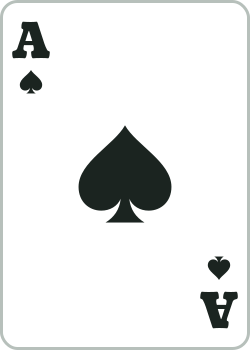
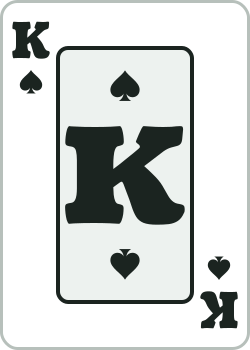
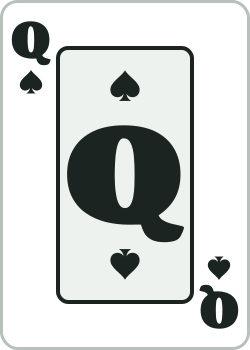
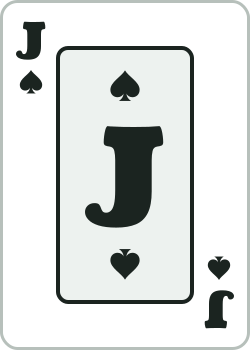
- Players
- 4, in 2 teams of 2
- You need
- A standard 52-card deck, plus paper and a pencil for the score
- Deal
- 13 cards each. The whole deck is dealt.
- Goal
- Win at least as many tricks as your team bid, without piling up extra tricks
- Game ends
- The first team to 500 points wins
- Playing time
- About 1 hour
Quick start
- Four players form two teams, and partners sit across from each other. Deal out the whole 52-card deck, so everyone has 13 cards. Spades are trump in every hand.
- Starting on the dealer’s left, each player bids how many tricks they expect to win. Add the two partners’ bids together. That total is what the team must win.
- A bid of 0 is called nil. It is a promise to win no tricks, worth 100 points if you keep it and minus 100 if you do not.
- The player on the dealer’s left leads any card except a spade. Going clockwise, everyone plays one card and must follow the suit led if they can.
- The highest spade wins the trick. With no spade, the highest card of the suit led wins. Spades cannot be led until one has been played, unless you hold nothing else.
- Making the bid scores 10 points per trick bid, plus 1 per extra trick. Falling short loses 10 per trick bid. Every 10 extra tricks cost 100. First team to 500 wins.
Rule sheet and score sheet
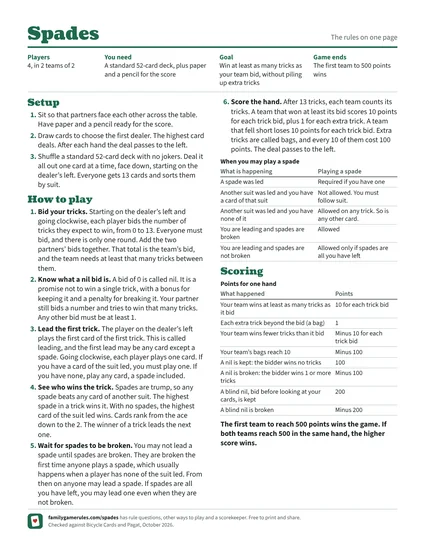
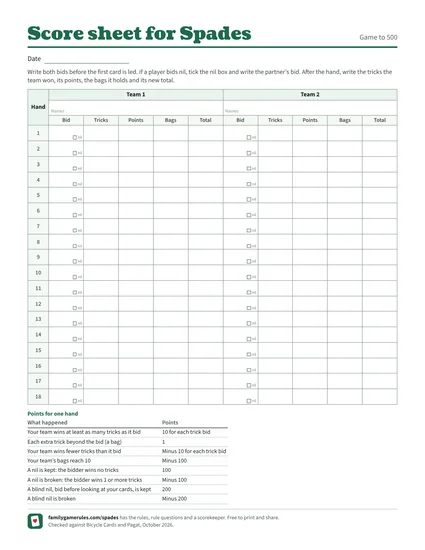
Print the whole game on one page, and a score sheet made for Spades. Both are free PDFs for Letter paper.
Setup
4 players in 2 teams of 2. Versions for 2 and 3 players are further down.
You need: A standard 52-card deck with the jokers taken out.
| In the set | Count |
|---|---|
| Spades (always trump) | 13 |
| Hearts | 13 |
| Diamonds | 13 |
| Clubs | 13 |
| Total | 52 |
- In every suit the ace is the highest card and the 2 is the lowest.
- You also need paper and a pencil to keep score.
- Sit so that partners face each other across the table. Have paper and a pencil ready for the score.
- Draw cards to choose the first dealer. The highest card deals. After each hand the deal passes to the left.
- Shuffle a standard 52-card deck with no jokers. Deal it all out one card at a time, face down, starting on the dealer’s left. Everyone gets 13 cards and sorts them by suit.
| Players | Each player gets | Notes |
|---|---|---|
| 4 | 13 cards | The whole deck is dealt. Nothing is left over. |
| 3 | 17 cards | 1 card is left over and set aside. |
| 2 | 13 cards | Nobody deals. Each player draws a hand from the deck, and 26 cards are discarded. |
Each player’s hand
13 cards. Your partner sits across from you.
- Any fair way of picking the first dealer works. After that the deal always moves one seat to the left.
- With 2 or 3 players the hands are made up differently. See the versions further down.
How to play
A hand starts with one round of bidding. Then 13 tricks are played and the hand is scored. A trick is one trip around the table: each player plays one card, and the best card wins all four.
-
Bid your tricks
Starting on the dealer’s left and going clockwise, each player bids the number of tricks they expect to win, from 0 to 13. Everyone must bid, and there is only one round. Add the two partners’ bids together. That total is the team’s bid, and the team needs at least that many tricks between them.
- A bid does not have to be higher than the bids before it. Once made, a bid cannot be changed.
- Nobody names a suit, because spades are trump in every hand.
- Suppose you bid 3 and your partner bids 2. Your team’s bid is 5, and it does not matter which of you wins the 5 tricks.
- The team’s bid is also called its contract.
- The four bids can add up to more or less than 13.
-
Know what a nil bid is
A bid of 0 is called nil. It is a promise not to win a single trick, with a bonus for keeping it and a penalty for breaking it. Your partner still bids a number and tries to win that many tricks. Any other bid must be at least 1.
- A nil is scored apart from your partner’s bid. Only your partner’s tricks count toward that bid.
- Some groups also allow blind nil. This is a nil bid made before you look at your cards, for double the bonus or double the penalty. Agree before the game whether to allow it.
- The usual condition is that you may bid blind nil only when your team is at least 100 points behind.
- After all four players have bid, the blind nil bidder may swap 2 cards with their partner. The bidder passes 2 cards face down. The partner picks them up and passes 2 cards back the same way.
-
Lead the first trick
The player on the dealer’s left plays the first card of the first trick. This is called leading, and the first lead may be any card except a spade. Going clockwise, each player plays one card. If you have a card of the suit led, you must play one. If you have none, play any card, a spade included.
- Playing a card of the suit led is called following suit.
- When you cannot follow suit, you do not have to play a spade. You also never have to beat the cards already played. The only duty is to follow suit when you can.
-
See who wins the trick
Spades are trump, so any spade beats any card of another suit. The highest spade in a trick wins it. With no spades, the highest card of the suit led wins. Cards rank from the ace down to the 2. The winner of a trick leads the next one.
- The full order in every suit is ace, king, queen, jack, 10, 9, 8, 7, 6, 5, 4, 3, 2.
- A card that is neither a spade nor of the suit led can never win a trick.
- A trick counts for the team, whichever partner won it.
-
Wait for spades to be broken
You may not lead a spade until spades are broken. They are broken the first time anyone plays a spade, which usually happens when a player has none of the suit led. From then on anyone may lead a spade. If spades are all you have left, you may lead one even when they are not broken.
- The limit is only on leading. Playing a spade because you cannot follow suit is allowed on any trick, the first included.
-
Score the hand
After 13 tricks, each team counts its tricks. A team that won at least its bid scores 10 points for each trick bid, plus 1 for each extra trick. A team that fell short loses 10 points for each trick bid. Extra tricks are called bags, and every 10 of them cost 100 points. The deal passes to the left.
- A team that falls short gets nothing for the tricks it did win.
- Bags are counted across the whole game, hand after hand.
| What is happening | Playing a spade |
|---|---|
| A spade was led | Required if you have one |
| Another suit was led and you have a card of that suit | Not allowed. You must follow suit. |
| Another suit was led and you have none of it | Allowed on any trick. So is any other card. |
| You are leading and spades are broken | Allowed |
| You are leading and spades are not broken | Allowed only if spades are all you have left |
Example: a low spade wins and breaks spades
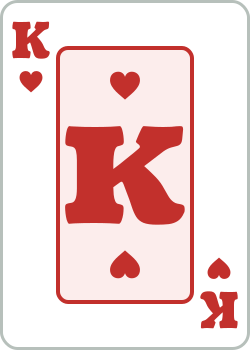
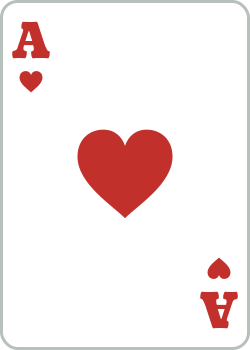
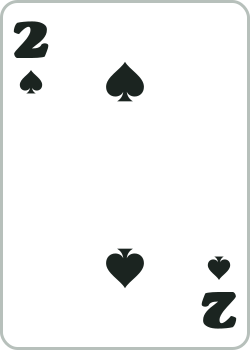
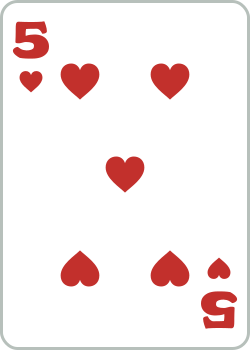
No spade has been played yet in this hand. South leads the king of hearts and West plays the ace of hearts. North has no hearts and plays the 2 of spades. East still holds a heart and must follow suit, so East plays the 5 of hearts. North’s 2 is the only spade in the trick, so it wins, even against an ace. Spades are now broken. North leads the next trick and may lead a spade.
South leads
West
North
The only spade, so it wins
East
Scoring
Partners score as one team. Add up the tricks both partners won and compare the total with the team’s bid. A nil is scored separately and added on top.
| What happened | Points |
|---|---|
| Your team wins at least as many tricks as it bid | 10 for each trick bid |
| Each extra trick beyond the bid (a bag) | 1 |
| Your team wins fewer tricks than it bid | Minus 10 for each trick bid |
| Your team’s bags reach 10 | Minus 100 |
| A nil is kept: the bidder wins no tricks | 100 |
| A nil is broken: the bidder wins 1 or more tricks | Minus 100 |
| A blind nil, bid before looking at your cards, is kept | 200 |
| A blind nil is broken | Minus 200 |
| Team bid | Tricks won | Score for the hand | Bags added |
|---|---|---|---|
| 5 | 5 | 50 | 0 |
| 5 | 7 | 52 | 2 |
| 5 | 8 | 53 | 3 |
| 7 | 7 | 70 | 0 |
| 5 | 4 | Minus 50 | 0 |
| 4 | 3 | Minus 40 | 0 |
- Bags are counted across the whole game. When a team’s count reaches 10, take 100 points off and start the count again. Bags past 10 carry over. A team with 8 bags that takes 3 more loses 100 points and starts again with 1 bag.
- The nil bonus or penalty is added to whatever the partner’s bid wins or loses.
- When a nil fails, the tricks the nil bidder won do not count toward the partner’s bid. They do count as bags for the team, at 1 point each like any other bag.
- A team that falls short of its bid gets nothing for the tricks it did win.
- Scores can go below zero.
- If the two scores are tied at the end, play one more hand.
The first team to reach 500 points wins the game. If both teams reach 500 in the same hand, the higher score wins.
One player keeps score on paper, with a column for each team. Write down each team’s bid before the first card is led. After the hand, write the points next to the bid and keep a running total. As long as a score is above zero, its last digit shows how many bags that team holds.
A worked example: three hands
This is how the first three hands of a game might go. Your team bids low each time, and its extra tricks add up to 10 bags in the third hand. The running score is 44 to minus 60 after hand 1, then 87 to 91, then 40 to 141.
| What happened | Goes to | Points |
|---|---|---|
| Hand 1: your team bids 4 and wins 8 tricks, for 40 plus 4 bags | Your team | 44 |
| Hand 1: the other team bids 6 and wins only 5 tricks | Other team | −60 |
| Hand 2: your team bids 4 and wins 7 tricks, for 40 plus 3 bags | Your team | 43 |
| Hand 2: a player on the other team bids nil and wins no tricks | Other team | 100 |
| Hand 2: that player’s partner bids 5 and wins 6 tricks, for 50 plus 1 bag | Other team | 51 |
| Hand 3: your team bids 5 and wins 8 tricks, for 50 plus 3 bags | Your team | 53 |
| Hand 3: those 3 bags bring your team’s count to 10 | Your team | −100 |
| Hand 3: the other team bids 5 and wins 5 tricks | Other team | 50 |
| Your team | 40 | |
| Other team | 141 |
Scorekeeper
Two teams playing to 500. Each hand takes the two team bids, any nil or blind nil, and the tricks won. For a failed nil it also needs the tricks the nil bidder won. It scores the hand, counts bags, takes off 100 at every 10 bags and keeps the running totals. It works in this browser, keeps the game if the page reloads, and needs no account.
Other ways to play
Spades for 3 players
Everyone plays for themselves. Deal 17 cards each and set the 1 leftover card aside. Bid in turn from the dealer’s left. The basic 3-player rules give no bonus for a bid of 0. The player holding the 2 of clubs leads it to the first trick. If the 2 was set aside, the 3 of clubs is led. The others must play a club if they can. A player with no clubs may play any card, a spade included. Then play as in the 4-player game. Making your bid scores 10 points per trick bid, and each extra trick costs you 10 of those points. Bid 4 and win 5, and you score 30. Falling short loses 10 per trick bid. Play to 300, 400 or 500. Once anyone gets there, the highest score wins.
Spades for 2 players
Nobody deals. Put the shuffled deck face down between you and take turns. On your turn, look at the top card without showing it. To keep it, put it in your hand, then look at the next card and discard that one face down. To refuse it, discard it face down and take the next card, which you must keep. Go on until the deck runs out. Each player then holds 13 cards, and the 26 discards stay out of play. Both players bid, then the 13 tricks are played and scored as in the 4-player game, each player for themselves. Some groups draw 2 cards at a time, look at both and keep 1. The rule sources we checked do not say who goes first, so swap each hand who draws, bids and leads first.
House rules and other versions
- Softer scores for a failed bid
- In some rule sets a team that falls short of its bid scores nothing for the hand and loses nothing. Another version takes off 10 points for each trick the team was short. Bid 6 and win 4, and you lose 20.
- No nil bids
- The lowest bid is 1 and nobody may bid nil.
- No bag penalty
- Some groups drop the 100-point penalty, so each extra trick is worth 1 point and nothing more. Others take 1 point off for each extra trick in place of adding it, and also drop the penalty.
- Clubs on the first trick
- The player holding the 2 of clubs leads it, and everyone else must play their lowest club. A player with no clubs plays a heart or a diamond. No spades are allowed on this trick, and the highest club wins. A looser version lets a player with no clubs play a spade, and the highest spade then wins.
- Leading spades at any time
- Spades do not have to be broken. A spade may be led at any time.
- Dealer leads first
- The dealer leads the first trick, in place of the player on the dealer’s left.
- Jokers
- Add 2 jokers as the top 2 spades. The big joker beats the little joker, and both beat the ace of spades. The big joker is usually the one printed in full color. Take out the 2 of clubs and the 2 of diamonds to keep the deck at 52 cards.
- Jokers and high 2s
- Some joker games also raise two of the 2s. Take out the 2 of clubs and 2 of hearts. The trumps then run big joker, little joker, 2 of diamonds, 2 of spades, ace of spades and on down. The 2 of diamonds counts as a spade. Some groups raise only the 2 of spades.
- Blind nil differences
- Blind nil changes from group to group. Some do not allow it at all. Some score it at 100 points and a plain nil at 50. Some allow no passing of cards.
- Minimum team bid of 4
- Each team must bid at least 4 tricks between its two partners. If one partner bids nil, the other must bid at least 4. That lowest bid of 4 is called board.
- First hand without bidding
- Nobody bids on the first hand of a game. The hand is played as usual, and each team scores 10 points for each trick it wins.
- 10 for 200
- A team may bid 10 for 200. It scores 200 points for winning exactly 10 tricks and loses 200 for any other number. Some groups count 10 or more tricks as making it.
- Shorter and longer games
- Play to 200 or 300 points for a shorter game, or to 1000 for a long one. Some groups also end the game when a team’s score sinks to a set low mark, such as minus 200 or minus 500. That team loses.
- No partners
- Four players can each play for themselves, which is sometimes called cutthroat. Everyone makes and scores their own bid. One version adds a rule that you must beat the highest card played to the trick so far whenever you can.
- Misdeal with no spades
- If your group agrees to it beforehand, a player who is dealt no spades may call a misdeal. They show their hand and must call it before anyone on their team has bid. The cards are thrown in and the same dealer deals again.
Rule questions
How many cards do you get in spades?
13 each in the 4-player game. The whole 52-card deck is dealt, so nothing is left over. With 3 players, each gets 17 cards and 1 card is set aside. With 2 players, nobody deals. Each player draws from the deck until they hold 13 cards.
How does bidding work in spades?
The player on the dealer’s left bids first, and the bidding goes clockwise once around the table. Each player names a number of tricks from 0 to 13. Nobody may pass, and a bid cannot be changed. The two partners’ bids are added together to make the team’s bid. A bid of 0 is a nil, so the lowest ordinary bid is 1.
Who leads first in spades?
The player on the dealer’s left. They may lead any card except a spade. Some groups play it differently: the holder of the 2 of clubs leads it, or the dealer leads. Settle that before the first hand.
When can you lead spades?
Once spades are broken, which means a spade has already been played in that hand. This usually happens when someone cannot follow suit and plays one. Before then, you may lead a spade only if spades are all you have left.
Can you play a spade on the first trick?
Yes, if you have no card of the suit led. A player who cannot follow suit may play any card on any trick. The only first-trick limit is that the leader may not lead a spade. Some groups do ban spades on the first trick, so check your house rule.
What happens if you do not make your bid in spades?
Your team loses 10 points for each trick it bid. Bid 6 and win 5, and your score drops by 60. The 5 tricks you won count for nothing. Some rule sets are gentler and give the team 0 for the hand.
What are bags, and what is the penalty?
Bags are the tricks a team wins beyond its bid. Each one scores 1 point. They are counted across the whole game, and every time a team’s count reaches 10 it loses 100 points. Bags past 10 carry over toward the next 10. Bags are also called overtricks or sandbags.
What happens if you bid nil and win a trick?
Your team loses 100 points. Your partner’s bid is still scored in the usual way. The tricks you won do not count toward your partner’s bid, but they do count as bags for your team.
When can you bid blind nil?
Only if your group allows it, and usually only when your team is at least 100 points behind. You bid it before you look at your cards. After the bidding you may pass 2 cards face down to your partner and get 2 back. Winning no tricks scores 200 points. Winning any trick loses 200.
What if both teams reach 500 in the same hand?
The team with the higher score wins. If the two scores are exactly the same, play one more hand.
What is the penalty for reneging in spades?
It depends on your group, because the two main rule sources we checked set no penalty. A renege is failing to follow suit when you could have. Two penalties are common. In one, the team that reneged automatically fails its bid for that hand. In the other, 3 tricks are added to that team’s bid. Agree on one before you play.
How do you keep score in spades?
Give each team a column and write down both team bids before play starts. A made bid scores 10 points for each trick bid plus 1 for each bag. A failed bid loses 10 for each trick bid. Add 100 for a nil that was kept, or take off 100 for one that was broken. Take off 100 when a team’s bags reach 10. Keep a running total to 500.
Words used in Spades
- Trick
- One round in which each player plays one card. A hand has 13 tricks. Some players call a trick a book.
- Trump
- A suit that beats all the others. In this game spades are trump in every hand.
- Lead
- To play the first card of a trick.
- Follow suit
- To play a card of the same suit as the card that was led.
- Bid
- The number of tricks a player says they will win. The two partners’ bids added together are the team’s bid, also called the contract.
- Nil
- A bid of 0. It is a promise to win no tricks in that hand.
- Blind nil
- A nil bid made before the bidder looks at their cards. It is worth twice as much as a nil.
- Bag
- A trick a team wins beyond its bid. Also called an overtrick or a sandbag.
- Sandbagging
- Collecting bags. The 100-point penalty for every 10 bags is known as the sandbagging rule.
- Set
- Falling short of your bid. A team that is set loses points.
- Breaking spades
- Playing the first spade of a hand. After that, spades may be led.
- Renege
- Failing to follow suit when you could have.
- Board
- A bid of 4 tricks, in groups where that is the lowest bid a team may make.
- Boston
- Winning all 13 tricks in one hand.
- Cutthroat
- Spades played without partners, each player for themselves.
- Big joker and little joker
- The 2 jokers when they are added as the top trumps. The big joker is the higher one.
What you need
- A standard deck of playing cardsAll 52 cards are used. Keep the 2 jokers nearby if you want to try the joker version.Find it on Amazon (A standard deck of playing cards, opens in a new tab)
- A spades score padOptional. Plain paper works, and so does the free printable score sheet.Find it on Amazon (A spades score pad, opens in a new tab)
As an Amazon Associate, we earn from qualifying purchases. How the site is paid for.
Checked against
These rules are written in our own words from Bicycle Cards and checked against Pagat. Sources last checked on October 11, 2026.
- First source: Bicycle Cards, Spades. The deal, one round of bidding from the dealer’s left, following suit, spades as trump, when spades may be led, 10 points per trick bid, 1 point per overtrick, the 10-bag penalty, the game to 500, the short game to 200, the tie rule, choosing the dealer and keeping score.
- Second source: Pagat, Spades. Partners and seating, 13 cards each, team bids, nil and blind nil, the first lead, breaking spades, the score for a failed bid, bags carrying over, both teams reaching 500, the 2-player and 3-player games and most of the variants.
Other sources we used (2)
- Wikipedia, Spades (card game). The two common renege penalties, the terms book, set, board and cutthroat, the minus 200 ending, misdeals by agreement, a check on the failed-bid score, and the other way of drawing hands for 2 players.
- Bicycle Cards, Spades with Jokers. The joker version: both jokers rank above the ace of spades, the full-color joker is the big one, and the 2 of clubs and 2 of diamonds are removed.
Where the sources differ (13)
| Topic | Bicycle Cards | Pagat | This page |
|---|---|---|---|
| Partners | The rules are written for each player bidding and scoring alone. Partners are not mentioned. | Four players in two fixed partnerships, with partners sitting opposite. A game without partners is listed as a variation. | The partnership game. Playing without partners is listed as a variant. |
| Score for a failed bid | 0 points for the hand. | Minus 10 points for each trick bid. | Minus 10 for each trick bid, which Wikipedia also gives. Scoring 0 is listed as a variant. |
| Lowest bid and nil | The lowest bid is 1. Nil is not mentioned. | A bid of 0 is allowed and is a nil, worth plus or minus 100. Any other bid must be at least 1. | Nil is in the main rules. Playing without nil is listed as a variant. |
| Blind nil | Not mentioned. | An option that some players allow, usually only when at least 100 points behind, with 2 cards swapped and 200 points at stake. | Described as an optional bid to agree on before the game. |
| Bag penalty | Says that in some games 10 bags cost 100 points, and counts bags for each player. | A standard rule, counted for each side. Bags past 10 carry over. | The penalty is in the main rules, counted by team. Playing without it is listed as a variant. |
| Points to win | Agreed before the game. 500 is common and 200 suits a short game. | 500. Targets of 300 and 1000 are listed as variations. | 500, with the other targets listed as a variant. |
| Both teams finishing together, and ties | A tie is settled by one more round. | If both sides reach 500 in the same hand, the higher score wins. A tie is not covered in the main rules. | The higher score wins, and a tie is played off with one more hand. |
| Choosing the first dealer | Draw cards. The highest card deals. | Chosen at random. | Draw cards, highest deals, with a note that any fair way works. |
| The first lead | The player on the dealer’s left leads. The only limit is the general rule on leading spades. | The player on the dealer’s left leads any card except a spade. | Uses Pagat’s wording. The two rules give the same result. |
| Number of players | Lists 2, 3, 4 and 5 or more players, with one set of rules for all. | 4 players in the main game, with separate sections for 6, 3 and 2. | 4 players, with Pagat’s 3-player and 2-player games as versions. |
| Jokers | On Bicycle’s separate Spades with Jokers page, both jokers rank above the ace of spades, and the 2 of clubs and 2 of diamonds are removed. | The 2 of clubs and 2 of hearts are removed. In the two versions described, the 2 of spades, or the 2 of diamonds and the 2 of spades, also rank above the ace. | Both are described under variants. |
| Renege penalty | Not stated. | Not stated. | Gives the two common penalties from Wikipedia and says to agree on one first. |
| Age | 13 and up. | Not stated. | No age line. Spades is a traditional game with no publisher to set one. |
What on this page is our own
- The playing time of about 1 hour is our estimate.
- The example trick, the three-hand scoring example and the table of sample scores are our own. Two rows of that table match examples on Bicycle’s page.
- The 26 discards in the 2-player game, the 8-plus-3 bag example and the 20-point example for tricks short are our arithmetic.
- No source says who draws, bids or leads first in the 2-player game. The advice to take turns is ours.
- Pagat says the 2-player game is scored like the 3-player or 4-player game. The page uses the 4-player scoring.
- The statement that the four bids need not add up to 13 rests on neither source limiting the total.
- The notes under What you need describe products and are not rules.
- Two points follow from the rules of play without being spelled out in the sources: you never have to beat the cards already played, and a card that is neither a spade nor of the suit led cannot win a trick.
- That a failed nil bidder’s tricks score 1 point each follows from Pagat counting them as bags. Pagat does not spell it out.
- The example of partners bidding 3 and 2 is our own.
- That the basic 3-player rules give no bonus for a bid of 0 is our reading of Pagat, which mentions such a bonus only in an optional variation.
- The pieces pictured at the top of the page are our own example.
Spotted a mistake? Email [email protected] and we'll check it against the sources.